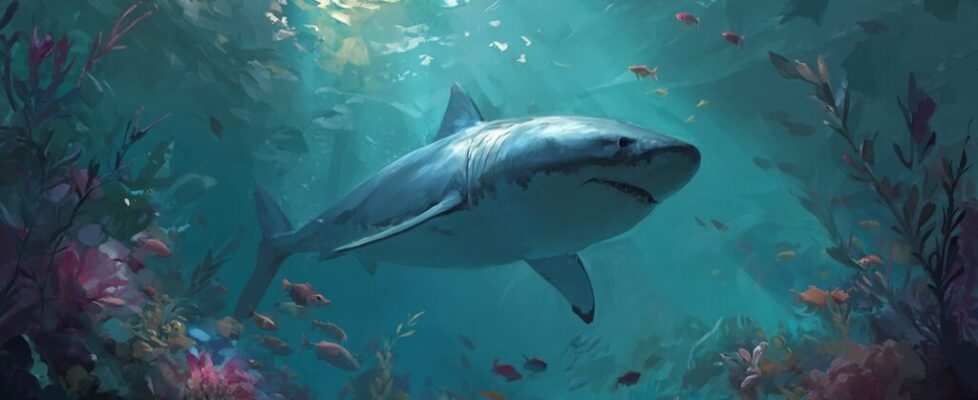
A few shark species are, indeed, dangerous wildlife. However, the public portrayal of these animals as villains and killers is overblown. What is the real life of a large shark like? How do they eat? How long do they live, and where do they migrate? Knowing about sharks in this way — especially how they think — helps us see them as part of our ocean world to be respected … and to be amazed by.
Our Wonderfest speaker is Dr.Stephen Palumbi, Professor of Marine Sciences at Stanford University. Steve is also Professor of Biology, Senior Fellow at Woods Institute for the Environment, and leader of The Palumbi Lab at Hopkins Marine Station, all at Stanford.
HOW: This event is free and unticketed ... and valuable. But what value does it have FOR YOU (and, indirectly, for society)? Accordingly, please use the DONATE button (below) to support Wonderfest in its nonprofit mission to share the scientific outlook.
Wonderfest Science Envoys are early-career researchers with enhanced communication skills and aspirations. Following short talks on provocative modern science topics, these two Science Envoys will answer questions with insight and enthusiasm:
• Stanford biologist Marina Luccioni on Fish that Make Dreams — Hawaiian traditional knowledge from the 1400s references “nightmare fish.” Indeed, eating the heads of certain fish species does induce dizziness, severe hallucinations, and nightmares. How do these fish come to contain and accumulate neurotoxins, and how do those molecules cause hallucinations? Of equal importance, how do we do such science that is respectful of indigenous knowledge and fair to local communities and ecosystems?
• Stanford ecologist Ryan Rogers on What’s Up with Wetlands? — Tidal wetlands are environments of constant change: tides rise and fall, salinity shifts, and waters stay perpetually in motion. In these challenging conditions, seagrasses flourish, creating underwater meadows that support rich and diverse communities. Studying these ecosystems reveals how biodiversity sustains them, and why protecting wetlands and estuaries is critical for resilient coastlines.
This interactive science presentation, free and unticketed, is produced by Wonderfest in partnership with Marin Science Seminar.
HOW: This event is free and unticketed ... and valuable. But what value does it have FOR YOU (and, indirectly, for society)? Accordingly, please use the DONATE button (below) to support Wonderfest in its nonprofit mission to share the scientific outlook.
Wonderfest Science Envoys are early-career researchers with special communication skills and aspirations. Following short talks on provocative modern science topics, these two Science Envoys will answer questions with insight and enthusiasm:
• UC Berkeley astrophysicist Natasha Abrams on Black Holes: Discovering the Invisible — Black holes are among the most extreme objects in the universe. They push the boundaries of our knowledge, holding many unsolved mysteries. This talk will explore black holes from “small” to enormous, including how to detect these invisible marvels. In the process, we will probe the very frontiers of astrophysics.
• Stanford marine biologist Will Johnson on The Structure of Kelp Forests — Kelp forests constitute one of the most diverse ecosystems on Earth, and they’re hidden right beneath the waves of our coastline. To research how these ecosystems function, we need to study what lives there. Come learn how scientific diving and modern genetics are helping us unravel the complex structure of kelp forests.
This interactive science presentation, free and unticketed, is produced by Wonderfest in partnership with Marin Science Seminar.
WHAT: Ask a Science Envoy: Black Holes; Kelp Forests
WHO: Natasha Abrams (UC Berkeley) & Will Johnson (Stanford), Wonderfest Science Envoys
HOW: What value does this free science experience have for you and, indirectly, for society? Accordingly, please donate to nonprofit Wonderfest via the Eventbrite box, below.