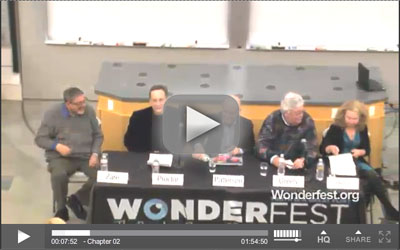

Does Corporate Funding Corrupt Science? – Panel Discussion
|
|
|
Some 65% of all research and development in the U.S. is funded by private interests. History shows that the corporate funding of scientific research can be problematic — the tobacco industry offers a potent example. When corporations fund science, is truth the ultimate goal, or is stockholder profit? Please join five outstanding scholars and teachers as they take part in a panel discussion that asks, “Does Corporate Funding Corrupt Science?”:
Lisa Bero, Professor of Health Policy, UCSF Prof. Bero served as: (1) advisor to the World Health Organization (WHO) Department of Essential Medcicines and Pharmaceutical Policies, (2) member of the WHO Essential Medicines Committee, and (3) member of the Pan American Health Organization Advisory Committee on Health Reseach. She is Director of the San Francisco branch of the United States Cochrane Center. And, for 12 years, she was an elected member of the Cochrane Collaboration Steering Group. She serves on several national and international committees related to conflicts of interest and research, such as the Institute of Medicine Committee on Conflict of Interest in Medical Research, Education, and Practice.
Hank Greely, Professor of Law, Stanford
Dave Patterson, Professor of Computer Science, UC Berkeley A measure of the success of these projects is the list of awards won by Prof. Patterson and his teammates: the C & C Prize, the IEEE von Neumann Medal, the IEEE Johnson Storage Award, the SIGMOD Test of Time Award, the ACM-IEEE Eckert-Mauchly Award, and the Katayanagi Prize. He was also elected to the American Academy of Arts and Sciences, National Academy of Engineering, National Academy of Sciences, the Silicon Valley Engineering Hall of Fame, and Fellow of the Computer History Museum. The full list includes about 30 awards for research, teaching, and service.
Robert Proctor, Professor of History, Stanford
Richard Zare, Professor & Chair of Chemistry, Stanford Prof. Zare is the Marguerite Blake Wilbur Professor in Natural Science. He earned his Ph.D. in chemical physics in 1964 from Harvard University. He has won more awards for outstanding research than we can possibly enumerate here. Prof. Zare is a member of the National Academy of Sciences; he was awarded the National Medal of Science in 1983; and, just two years ago, he won the highest honor bestowed by the American Chemical Society: the Priestley Medal. With his colleagues at Stanford’s Zare Lab, Prof. Zare continues to investigate many diverse aspects of physical chemistry. He loves to teach, and he offers crucial support to Wonderfest by serving as both board member and technical advisor. These experts will examine at least five major industries: pharmaceuticals (Bero), biomedicine (Greely), computer science (Patterson), tobacco (Proctor), and chemistry (Zare). Subsequent discussion of the various controversies promises to be enlightening and important. Does truth triumph in corporation-funded research? Under what conditions might it not? WONDERFEST and the Stanford Chemistry Department jointly present a very special panel discussion. Come take part! Co-Sponsor: Stanford Chemistry Dept.
|